Aug 17, 2026
What is Legal Drafting? Meaning, Types, and Importance in India (2026)
Every complaint filed in a district court, every bail application argued before a magistrate, Every plaint filed in a district court, every bail application argued before a magistrate, every contract signed between two businesses, every will that decides who inherits what — all of it depends on one thing: the quality of the drafting behind it. Legal drafting is often called the backbone of legal practice. Unlike ordinary writing, it demands precision, clarity, and an acute awareness of consequences. A single misplaced comma or an undefined term can trigger years of litigation or render an entire agreement unenforceable.
This guide covers what legal drafting means, how it differs from legal writing, its core principles, its main categories, the drafting process, common mistakes to avoid, and how the 2026 shift to India's new criminal laws has changed the drafting landscape. Along the way, we'll show how WebLex organizes this work into two focused services — Legal Drafting and Legal Documentation — so you know exactly where to turn for what you need.
What is Legal Drafting? - Definition and Meaning
In the broadest sense, legal drafting is the process of preparing any legal document — petitions, affidavits, notices, deeds, contracts, wills — so that it is clear, accurate, and enforceable under law. It is the strategic conversion of legal ideas and intentions into documentation that will be interpreted strictly, often years later, sometimes by a court that has never met the parties involved.
A well-drafted legal document does three things:
-
States facts clearly — leaving no room for confusion or double meaning.
-
Follows applicable law — every clause complies with current statutes and rules.
-
Protects the interests of the parties — rights, obligations, and remedies are spelled out precisely.
Legal Drafting vs Legal Writing - What is the Difference?
Many people confuse legal drafting with legal writing. They are not the same.
|
Feature |
Legal Drafting |
Legal Writing |
|---|---|---|
|
Purpose |
Creates enforceable legal documents (contracts, petitions, agreements) |
Communicates legal analysis or opinion (articles, case briefs, memos) |
|
Output |
Binding documents used in courts or transactions |
Non-binding written analysis or commentary |
|
Who Uses It |
Advocates, corporate lawyers, conveyancers |
Law professors, legal researchers, journalists |
|
Legal Effect |
Has direct legal consequences |
No direct legal effect |
|
Examples |
Sale deed, bail application, FIR complaint, MOU |
Case commentary, legal blog, research paper |
In short - legal drafting creates documents that courts enforce. Legal writing explains or analyzes the law.
Key Principles of Legal Drafting
A thorough understanding of relevant laws, regulations, and precedent is essential — but legal knowledge alone isn't enough. Every strong draft rests on these principles:
-
Clarity and Conciseness — Use clear, unambiguous language. Avoid jargon or archaic legalese ("hereinafter," "witnesseth," "party of the first part") where a plainer phrase achieves the same legal effect.
-
Precision and Accuracy — Every word should be chosen deliberately. "Shall," "may," and "must" carry distinct legal weight:
-
Shall — imposes an obligation.
-
May — grants permission or discretion.
-
Must — imposes a mandatory requirement.
-
Using these interchangeably is one of the most common — and consequential — drafting errors.
-
Logical Structure — A well-organized draft with proper headings, numbered clauses, defined terms, and a clear flow (recitals → definitions → operative clauses → remedies → miscellaneous) is easier to interpret and enforce.
-
Consistency — Defined terms must stay consistent throughout. Switching between "Purchaser" and "Buyer" for the same party invites disputes over whether they mean the same thing.
-
Compliance with Current Law — Especially critical in India after July 2024. Which framework applies — BNS, BNSS, BSA, or the older codes — depends on the date of the alleged offence, the stage of proceeding, and the type of document, not a blanket rule.
-
Foreseeability — Skilled drafters anticipate future disputes and changed circumstances, building in indemnity, force majeure, and termination clauses in advance rather than reactively.
-
Client-Specific Customization — A document must be tailored to the actual facts and needs of the matter, not lifted wholesale from a generic template.
Types of Legal Drafting in India
Legal drafting encompasses a wide variety of documents, each serving its own function. Here are the main types of legal drafting every legal professional in India should know:
1. Contract and Agreement Drafting
Contract drafting is the most frequent form of legal document writing, and it involves creating agreements that establish rights and obligations between two or more parties.
Common examples: Sale agreements, partnership deeds, MOUs, employment contracts, franchise agreements.
2. Litigation and Pleading Drafting
Pleadings are the formal written statements filed by each party in a lawsuit. They set out the facts and legal arguments that support their case. In India, this is primarily governed by the Code of Civil Procedure, 1908.
Common examples: Plaints, written statements, bail applications, writ petitions, revision petitions, criminal appeals.
3. Legislative Drafting
Legislative drafting refers to the creation of laws, regulations, and statutes. It requires special care to avoid loopholes and ambiguity.
Common examples: Parliamentary bills, ordinances, government notifications, rules and regulations.
4. Conveyancing and Property Drafting
Conveyancing is a specialized branch of drafting that deals with the transfer of ownership of immovable property (land and buildings) from one person to another. The term 'convey' literally means to transfer or deliver something to someone.
Common examples: Sale Deed, Lease Deed, Mortgage Deed, or Gift Deed.
5. Corporate and Commercial Drafting
This includes documents used in business operations - board resolutions, shareholders agreements, compliance filings, due diligence reports, and regulatory submissions.
6. Affidavit, Will, and Notarial Drafting
Power of attorney, affidavits, wills, trust deeds - these require precise language because even a small error can make the document unenforceable.
7. Legal Notice Drafting
A legal notice is often the first formal step before litigation. It must state the facts, the legal ground, and the relief sought - all within the framework of applicable law.
How WebLex Organizes Legal Drafting: Two Focused Services
Because court-facing drafting and transactional documentation are such different disciplines, WebLex splits the broad umbrella of "legal drafting" into two dedicated tracks — so you can go straight to the right one instead of wading through a single undifferentiated list.
1. Legal Drafting — for the Supreme Court and High Courts
This service covers litigation and pleading drafting — the category of legal drafting governed by court procedure rather than contract law. WebLex prepares:
-
Writ petitions (civil and criminal)
-
Special Leave Petitions (SLPs)
-
Bail applications
-
Appeals, reviews, and revision petitions
-
Transfer petitions
2. Legal Documentation — for contracts, agreements, and personal documents
This service covers everything else that the broader "legal drafting" umbrella traditionally includes — contract drafting, conveyancing, corporate documentation, and notices — organized by real-world use case:
-
Business Contracts — NDAs, Non-Compete Agreements, MoUs, Partnership Deeds, Franchise, Joint Venture, and Vendor Agreements
-
HR & Employment — Employment Contracts, POSH Policy, ESOP Policy, Offer and Termination Letters
-
Property & Real Estate — Sale Deeds, Rent Agreements, Gift Deeds, Power of Attorney, Commercial Lease Agreements
-
Legal Notices — Legal Notice, Cheque Bounce Notice, Show Cause Notice, Legal Notice for Recovery of Dues
-
Personal Documents — Online Will, Legal Heir Certificate, Name Change, Marriage Registration
-
Startup Documents — Founder's Agreement, Term Sheet, Shareholder Agreement
-
Website & Digital Policies — Terms of Use, Privacy Policy, Cookie Policy
Quick way to decide which service you need: if it's going before a judge, it's Legal Drafting. If it's an agreement, deed, notice, or personal document that two or more parties will sign (or that you'll rely on outside a courtroom), it's Legal Documentation. If you're unsure, WebLex's Legal Consultation service can point you to the right one before you commit.
Essential Elements of a Well-Drafted Document
Regardless of type, most legal documents share a common structural backbone:
-
Title — identifies the nature of the document.
-
Parties — full legal names and addresses.
-
Recitals/Background — context explaining why the document exists.
-
Definitions Clause — defines key terms to avoid ambiguity.
-
Operative Provisions — the substantive rights and obligations.
-
Representations and Warranties — factual assurances made by parties.
-
Indemnity and Liability Clauses — allocation of risk.
-
Dispute Resolution Clause — arbitration, mediation, or jurisdiction.
-
Termination Clause — conditions for ending the agreement.
-
Miscellaneous Provisions — severability, notices, governing law, entire agreement.
-
Execution Block — signatures, witnesses, dates, seals/stamping as required.
Importance of Legal Drafting in Indian Law
The importance of drafting in law cannot be overstated. Here is why:
|
Why It Matters |
Explanation |
|---|---|
|
Legal Compliance |
Properly drafted documents ensure legal compliance, minimize ambiguities, and prevent future disputes. |
|
Protects Rights |
A good draft clearly defines the rights, obligations, and remedies of each party — leaving no room for exploitation. |
|
Prevents Disputes |
It ensures clarity, legal compliance, and reduces the risk of disputes or litigation due to misinterpretation. |
|
Court Enforceability |
Courts rely on the exact language of documents. A poorly drafted agreement may not hold up in court. |
|
Professional Credibility |
A poorly drafted legal document can lead to misinterpretation, financial loss, or even litigation. Your drafting reflects your competence as a legal professional. |
Legal Drafting Under New Criminal Laws - BNS, BNSS, BSA (2026 Update)
This is the biggest shift in Indian legal drafting in decades.
Three new criminal laws - Bharatiya Nyaya Sanhita (BNS), Bharatiya Nagarik Suraksha Sanhita (BNSS), Bharatiya Sakshya Adhiniyam (BSA) - replaced IPC, CrPC and Evidence.
Act from 1 July 2024.
What does this mean for legal drafting?
-
Use BNS/BNSS/BSA sections when drafting FIRs, criminal complaints, legal notices citing penal provisions, or bail applications for matters arising on or after 1 July 2024.
-
For offences before 1 July 2024, continue citing IPC sections.
-
The BSA's most significant practical change is the formal recognition and enhanced admissibility of electronic records - emails, WhatsApp messages, call recordings, and electronic documents - with clearer standards for authentication.
The replacement of the colonial-era IPC, CrPC, and Indian Evidence Act created a massive re-skilling crisis in the Indian legal fraternity. Millions of lawyers trained on the IPC 420 (cheating) framework suddenly had to navigate BNS 318.
Every advocate, law student, and legal drafting service provider must now draft under the new framework. Old templates should be reviewed and updated after changes in law. However, no single format becomes automatically invalid. The relevant court rules, filing requirements, stamp duty, registration rules and special laws must also be checked.
Legal Drafting Service in India - What You Should Know
Not everyone can draft their own legal documents. This is where professional legal drafting services come in.
A legal drafting service in India connects you with experienced lawyers who draft documents on your behalf - contracts, legal notices, petitions, affidavits, agreements, and more. Whether you are an individual dealing with a property dispute or a startup incorporating a company, a professional drafting service ensures your documents are legally sound and enforceable.
When should you use a legal drafting service?
-
You need a contract or agreement but lack legal knowledge
-
You received a legal notice and need a proper reply
-
You are buying or selling property and need a sale deed drafted
-
You need court documents like bail applications or writ petitions
-
You are a business owner and need compliance documents
At Weblex, we provide reliable legal drafting services across India - handled by qualified legal professionals who understand both the old and the new legal framework.
Legal Drafting Online - How It Works in 2026
This is the most significant shift in Indian legal drafting in decades. From 1 July 2024, three new criminal laws replaced their colonial-era predecessors:
-
Bharatiya Nyaya Sanhita (BNS) — replaced the Indian Penal Code (IPC)
-
Bharatiya Nagarik Suraksha Sanhita (BNSS) — replaced the Code of Criminal Procedure (CrPC)
-
Bharatiya Sakshya Adhiniyam (BSA) — replaced the Indian Evidence Act
What this means for drafting:
-
Use BNS/BNSS/BSA sections when drafting FIRs, criminal complaints, legal notices citing penal provisions, or bail applications for matters arising on or after 1 July 2024.
-
For offences that occurred before 1 July 2024, continue citing the corresponding IPC sections.
-
The BSA's most practically significant change is the enhanced admissibility of electronic records — emails, WhatsApp messages, call recordings — with clearer authentication standards.
The transition created a genuine re-skilling challenge across the profession — lawyers trained for years on "IPC 420" (cheating) had to internalize its replacement, BNS Section 318, almost overnight. Every advocate, law student, and legal drafting service must now draft under the new framework; old templates need review rather than automatic assumption of validity. This is precisely the kind of check WebLex's litigation drafting team builds into every writ, bail application, and appeal it prepares — along with court rules, filing requirements, stamp duty, and registration rules specific to each matter.
How to Do Legal Drafting - A Simple Step-by-Step Process
Whether you are a law student learning the basics or a professional refining your legal drafting skills, here is the process:
-
Understand the Facts - Gather all relevant facts from the client or situation. Know what the document needs to achieve.
-
Research the Applicable Law - Identify the statutes, rules, and precedents that apply. In 2026, verify whether BNS/BNSS/BSA or old laws apply to your matter.
-
Create an Outline - Structure the document - title, parties, recitals, definitions, operative clauses, and signature blocks.
-
Draft with Precision - Use clear, simple, and unambiguous legal language. Every clause should have a distinct purpose.
-
Review and Revise - Cross-check facts, verify legal provisions, remove inconsistencies, and finalize.
Legal drafting is the foundation of legal practice. Every plaint filed, every bail application argued, every contract signed depends on the quality of drafting behind it.
Common Mistakes in Legal Drafting
-
Using vague language - Words like "reasonable" or "appropriate" without definition invite disputes
-
Not updating to new laws - Still citing IPC sections for post-July 2024 matters is a serious error
-
Copy-pasting from templates - Generic templates miss case-specific details and local legal requirements
-
Missing essential clauses - Dispute resolution, termination, indemnity, and force majeure clauses are often overlooked
-
Poor formatting - Courts expect documents in a specific legal drafting format. Ignoring this affects credibility
When to Use a Professional Drafting Service
-
You need court documents like bail applications or writ petitions. → Legal Drafting
-
You're facing arrest or have been named in an FIR and need to secure bail. → Legal Drafting
-
A lower court or authority's decision has gone against you and you want to challenge it before a High Court or the Supreme Court. → Legal Drafting
-
You need a contract or agreement but lack legal training. → Legal Documentation
-
You've received a legal notice and need a proper reply. → Legal Documentation
-
You're buying or selling property and need a sale deed. → Legal Documentation
Final Thoughts
Legal drafting is not paperwork — it's the discipline that holds the entire legal system together, from a simple rent agreement to a Supreme Court writ petition. The Indian legal landscape has changed more in the last two years than in the previous twenty, and the shift to BNS, BNSS, and BSA has made outdated templates and assumptions genuinely risky to rely on.
Whether you need a court petition drafted or a contract prepared, WebLex's split between Legal Drafting and Legal Documentation is designed to get you to the right expertise faster — without you having to first figure out which category your document falls into.
If you are looking for reliable legal drafting services, Weblex is here to help - with qualified professionals who understand Indian law as it stands today.
|
Legal Consultation |
Legal Documentation |
|---|---|
Disclaimer: This article is not a substitute for personalised legal advice — laws and legal requirements vary by facts, circumstances, and jurisdiction, and can change over time. Please consult a WebLex legal professional directly before acting on any information in this article.
Recent Blog

September 13, 2026
7 Benefits of Online Legal Drafting Services - Start With WebLex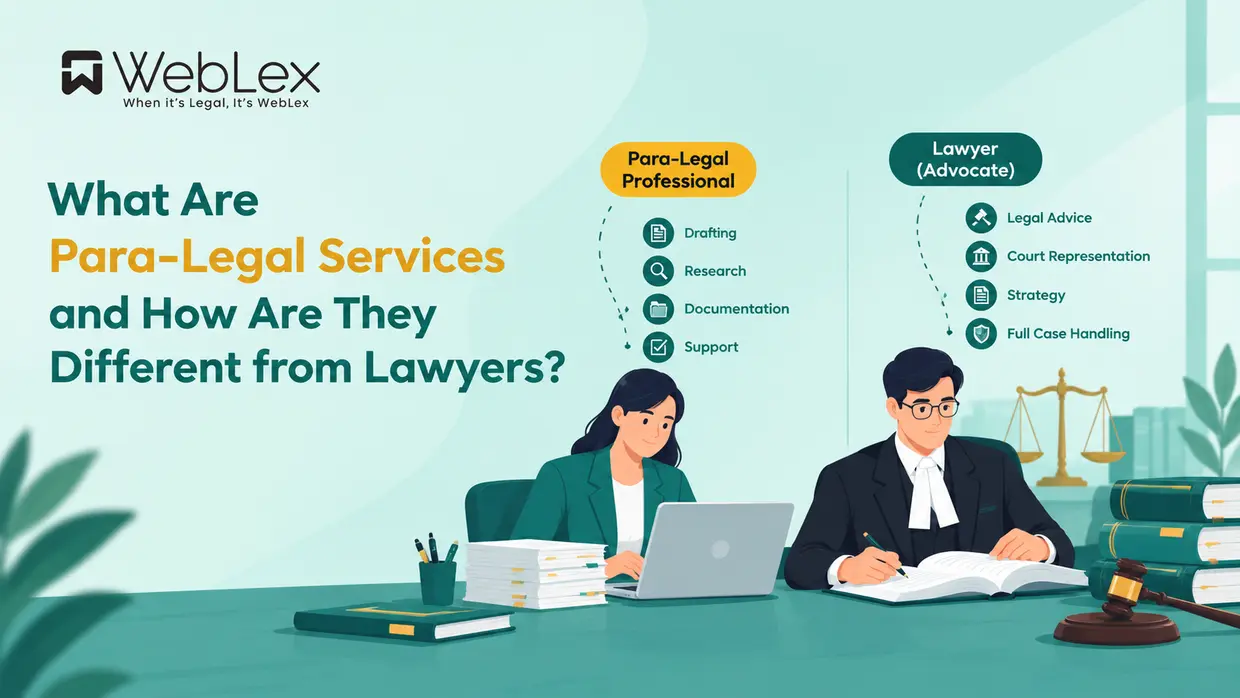
September 09, 2026
What Are Para-Legal Services and How Are They Different from Lawyers?
Browse by Tag

Frequently Asked Questions
What is legal drafting?
Legal drafting is the process of writing legal documents - such as contracts, petitions, affidavits, and agreements - that are clear, accurate, and enforceable under law.
What are the main types of legal drafting in India?
The main types of legal drafting include contract drafting, litigation/pleading drafting, legislative drafting, conveyancing, corporate drafting, and legal notice drafting.
Why is legal drafting important?
The importance of legal drafting lies in ensuring legal compliance, protecting the rights of parties, preventing disputes, and creating documents that courts can enforce.
How has legal drafting changed in India after 2024?
From 1 July 2024, FIRs are registered under BNS instead of IPC, criminal cases are tried under BNSS instead of CrPC, and evidence is governed by BSA instead of the Evidence Act. All criminal drafting must follow the applicable framework based on the date of the offence.
Can I get legal drafting done online in India?
Yes. Platforms like Weblex.co.in offer professional legal drafting service in India - where qualified lawyers draft your documents and deliver them digitally through legal drafting online.
What skills are needed for legal drafting?
Legal drafting skills include strong research ability, knowledge of Indian laws, attention to detail, and clear writing ability. It is essential for careers in corporate law, litigation, compliance and legal consulting.